26/03/2012
Witterings from Witney pens his observations from a recent seminar in London. He comes away with the predictable finding that professional politicians favour the system which gives them the best chance of personal power and influence, representative democracy."It is all very well campaigning for the laudable aim that those who govern us should be able to be 'hired and fired' by the electorate - but what is the point of exchanging one set of 'central controlists' for another", writes WfW."In other words", he asks, "what is the difference between a collection of dictators who cannot be hired and fired and the alternative who can?" We still, he laments, "end up with dictators".Appropriately, his piece is headed: "When will they ever learn?", and the answer is "never". We are going to have to teach them. It is down to us.We must not run away, however, with the idea that this is a new problem. From another observer of the political scene, one reads of the "apathy about Parliament which had spread". It was understandable, he said, "because it was the result of many disillusionments and lack of choice". He went on to say:The electorate had seen that the Parliaments it returned always, invariably, did exactly the opposite of that which had been promised and that which it had been returned to do, and felt, furthermore, that there was no means of remedying this, because no clearcut difference was apparent between the two parties which faced each other in the House; appalling though the Tory Party's record was, the Labour Party offered no clear alternative.
The writer that adds that people knew that voting for a Labour candidate instead of a Conservative, "would not make much difference; they knew that from experience".Far from being a contemporary piece, though, this is published in 1941, written of events in 1939, its author former Times foreign correspondent Douglas Reed. Read's pessimism was entirely warranted then and, while there was a brief resurgence of hope in 1945, that was quickly dashed. Ever since, we have been in the same old mould of British politics. Thus, I have to say again, nothing will change unless we make it change.And that thus brings us to the photograph â and the title of the piece. The photograph is absolutely genuine â not in any way photoshopped - straight out of the Imperial War Museum archives. It shows Churchill visiting Bradford on 4 December 1942, revealing what he really thinks of the people. Where Churchill leads, others follow. This is precisely what our politicians were doing to us then, and it is precisely what they are doing to us now.COMMENT THREAD 25/03/2012
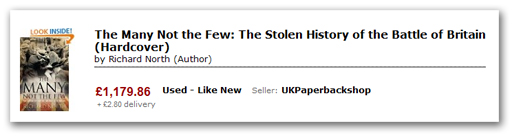
The availability of additional material on-line from the National Archives has had me busily downloading thousands of pages of files. Of special interest are the Chiefs of Staff bundles. They not only add points of detail which support the thesis developed in
The Many Not The Few, they offer something that very few books are able to convey.
What comes over is quite how little attention was being devoted at the very highest level to the prospect of imminent invasion of the UK. Even when the threat is supposed to be at its most extreme, the Chiefs are considering the fate of areas as diverse as Malta, Greece, East Africa, Malaya and Hong Kong.
Remarkably, on 15 September - later marked out as Battle of Britain Day - the very date that invasion is expected when one might have thought that minds would be totally focused on impending doom, under consideration is the transfer of an Australian division to India.
Churchill might have wanted to convey the impression of England standing alone and embattled, but so many other geographical areas and campaigns are being considered that one really does get the impression that this is an Empire at war.
Even on the domestic campaign, though, in what is often called the Battle
for Britain, the air battle is by no means the only preoccupation. And this is because there are three pillars to this war.
The best known is the fight to clear the skies preparatory to an invasion, but simultaneously there are two others. One is the attack on morale â exemplified by the London Blitz. The other is the blockade, the attempt by the Nazis to choke off Britain's food and war supplies.
Once again Churchill likes to position this. He locates the most deadly phase as 1942-3, calling it the Atlantic War. The battle, though, starts earlier, and comes to a danger level far sooner than is commonly believed.
Hitler's blockade is actually launched on 29 November 1939, arguably the opening of the Battle for Britain â something which sends the purists into paroxysms of rage. Closer to their ideal is the date of the revision, 24 May 1940, but in each case the objective stayed the same: to "cripple the English economy by attacking it at decisive points". And it morphed into unrestricted submarine warfare on 17 August 1940.

By 29 August, the First Lord of the Admiralty, Labour Co-operative MP Albert Victor Alexander (pictured above), is worried. He tells his Cabinet: "A most serious situation has arisen". The enemy is concentrating a heavy attack on trade with submarines and aircraft, he said.
In the eight weeks up to 25 August, 143 ships had been lost, amounting to 564,000 tons. A number of ships had been damaged. The losses sustained during the most recent six days had been extremely serious â 15 ships totalling 92,000 tons sunk and 12 ships totalling 42,000 tons damaged.
Alarmingly, the situation had continued to deteriorate. Furthermore, it was felt that Churchill had contributed to the problem. On 1 July, as a precaution against invasion, he had instructed the Admiralty to "endeavour" to raise the flotilla in the "narrow seas" (the English Channel) to a strength of forty destroyers, with additional cruiser support.
These warships could only come from the convoy escorts, as Churchill was very obviously aware. "The losses in the Western Approach must be accepted meanwhile", he had written in his minute. By the end of September, those losses were reaching dangerous proportions.
The C-in-C Home Fleet, Admiral Sir Charles Forbes, had never been at ease with this situation. There would be sufficient warning, he argued, to permit destroyers to be employed on convoy escort and other duties. Should an invasion seem imminent, they could be rapidly called back.
This had become a running sore in the relations between Forbes and the Admiralty acting under the direct instructions of Churchill. The stand-off culminated in Forbes writing a letter, suggesting that "the Army, assisted by the Air Force, should carry out its immemorial role of holding up the first flight of an invading force". The Navy, he asserted, "should be freed to carry out its proper function â offensively against the enemy and in defence of our trade â and not be tied down to provide passive defence of our country, which has now become a fortress".

To Forbes in late August, Alexander had added his voice in support. Then, on 30 September, shipping minister Ronald Cross raised the alarm. "In a matter of this vital importance", he wrote in an urgent report to the War Cabinet, "remedial, measures should not be delayed". He urged an immediate increase in the number of escorts for the convoys.
Two days later, the First Sea Lord was writing a report in support of Forbes, for the Chiefs of Staff. He acknowledged that following the fall of France it had been necessary to keep ships on standby. But the time had come, to "review the necessity for keeping our naval forces in any instant state of readiness to repel invasion round our costs".
This was Admiral Dudley Pound, who was not suggesting, he said, that all naval forces should be removed from the east and south coasts. However, they should be reduced to the minimum necessary. The Army could hold out against any sudden invasion, until relief naval forces could arrive.
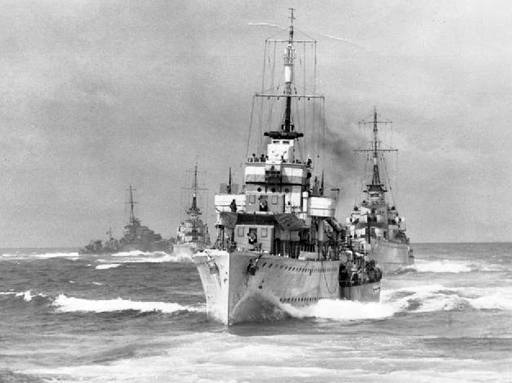
With a merchant ship of 4,600 tons having been lost on the previous day, and belated reports having been received of three other merchant ships sunk far out in the Atlantic, the very next day, 3 October, Pound's report went before the Chiefs of Staff Committee.
Joining him, the First Lord of the Admiralty, the C-in-C Home Fleet and the Shipping Minister in expressing their concerns about the shipping losses now came Minister of Food, Lord Woolton. He submitted a memorandum to the War Cabinet. During the last few weeks, he said: "I have been seriously disturbed by the extent of our food losses at sea". If the current rate of loss was sustained, imports would have to be increased, taking up a much larger proportion of shipping, with serious effect on other supplies.
Alongside Woolton's paper was yet another memorandum from Alexander. He repeated the point so heavily emphasised by Forbes that the only short-term way of improving the situation was "the return to trade protection of the forces which were withdrawn for anti-invasion duties".

What had been remarkable, and obviously quite unexpected, was how quickly and severely the shipping losses started to bite. The arithmetic offered by Ronald Cross attested to this. Imports in the first year of the war had been 43½ million tons, but September imports had been "disappointingly low", at three million tons.
Given the shipping losses already experienced, expected imports for the second year of the war had fallen to 42 million tons, and 34 million for the third year. But, at the then current rate of shipping loss, they were expected to drop to 32 million tons, as against the 34 million imported in the last full year of the First World War, when the population to be supplied had been 6.5 percent less.
These figures made no allowance for increased demands for shipping for military purposes in the Middle East and elsewhere, made worse by the closure of the Mediterranean. Thus, Cross was warning that shipping capacity was set to fall below survival level. By the third year of the war, Britain would no longer be able to feed its population and support the military campaigns.
On Friday 4 October, Churchill appeared to be responding to this chorus of concerns, when he addressed the War Cabinet. He had, he told his ministers, discussed the matter with the Defence Committee. Their view was that suitable weather for an invasion "was not likely to prevail on many occasions during the winter months", so it would be safe to divert a number of destroyers and anti-submarine trawlers from anti-invasion duties, to reinforce shipping escorts.
Despite this, on 8 October, the Prime Minister was in parliament ramping up the invasion threat. "Do not be lured into supposing the danger has is past", he said. On the contrary, "unwearying vigilance" had "at all costs" to be maintained.
Then, a week later, in Cabinet, under the agenda item "likelihood of invasion" Churchill told his colleagues that it would be premature to suppose that the danger of invasion had passed. Intelligence reports, he said, had indicated that enemy plans were still moving forward. In these circumstances, "it would not be possible for the Navy to withdraw any more of their forces from the invasion front in order to strengthen shipping escorts in the north-west approaches".
So, out in the Atlantic, the carnage continued. It was not until 31 October at a meeting of the Defence Committee, which Churchill chaired, that the Prime Minister finally agreed that the danger of an invasion was "relatively remote".

The dispositions and state of readiness of British forces would be adjusted to match what was judged to be a diminished threat throughout the winter. At last, the Navy was to get some of its escorts back. But Admiral Forbes was not to keep his job. On 2 December, he was relieved of his command.
Nearly a decade later, Churchill was to assert in his history of the Second World War that he was more concerned about the shipping crisis than he ever was about the invasion threat. But his text was strangely silent about his reasons for refusing to give convoy protection more priority.
Why after agreeing to release escorts on 4 October did he go back on his word on 15 October and why did it take until 31 October before he finally agreed to a reposition his forces? That is the subject of the
part II of this series when, with additional material, I will suggest some answers to that question.
21/03/2012
The rather pejorative nickname for the German Navy awarded by some newspapers during the early part of the Second World War was "the
scuttlers", presumably after the sinking of the Grand Fleet in Scapa
Flow in 1919, and the then more recent fate of the
Graf Spee...
By the same token, we need to call the British people "the grovellers",
after their response to the preposterous little oik, George Osborne, the
man masquerading as our chancellor.
There he goes, standing in the Commons, telling us how much money we are
going to give him, so he can spend it on his chums and other wastrels.
And instead of telling him to foxtrot oscar, we say, "yes sir, no sir,
three bags full sir", doff our caps and give him the money.
At the very least, if he wants our money, he should ask for it â and say
"please". We, on the other hand, should have the power to tell him to
foxtrot all by himself. That is called
Referism.
Currently, of course, we go through the charade of little Georgie asking
parliament for the money. But, supposedly independent of the
executive, it is stacked with Georgie's chums, who simply roll over and
say, "yes sir, no sir, three bags full sir", doff their caps and give
him the money.
In theory, if we don't like this, we can vote them out in a few years'
time, and vote the other lot back in. In practice, we can vote in
Labour, who will take even more money from us, or we can not quite vote
the not-the-Tories in, in which case an unelected coalition will take
even more money from us.
One can imagine, though, all those people who hold up their hands in
horror at the prospect of mere people deciding on how much of their
money the government should have. But then, John and many other kings
held up their hands in horror at the idea of nobles and then parliament
deciding on how much money they should get.
Now, instead of the divine right of kings, we have the divine right of
parliament. Parliament has spawned an executive which has become the
king. Lacking any clear division or separation of powers, there is no
longer any realistic or effective check on its ambitions.
And that is the way it will remain as long as we, the grovellers, allow
it. Yet there are more of us than there are of them. Why are we still
doffing our caps?
COMMENT THREAD 26/03/2012
We've known
this for years. Actually though, on the substantive point, the infestation is being blamed on "neglect at the building".
This is unlikely to be just simple "neglect" - rats need access to flowing water. As a rule of thumb, you can say with almost complete confidence that, if you have a rat problem in a building, there is a drain or sewer defect. This should not be happening. Read what I said about it
in 2008 - just as relevant now.
COMMENT THREAD 11/03/2012
Following the example of
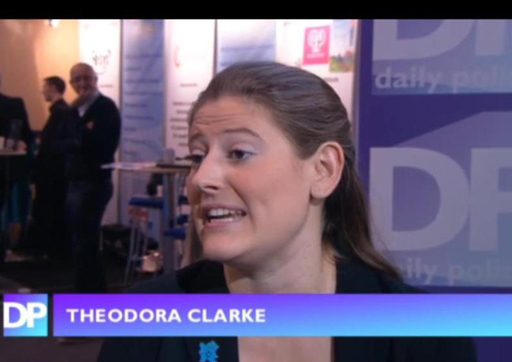
Madam Defarge, I've been keeping a little shit list of my own. Being a super-user of Facebook, I have access to all kinds of preening wannabes, whose monumental egos override their sense of caution and let people like me "out" them. Lately I've been keeping an eye on one
Theodora Clarke who penned this
little gem on the London riots.
"It is telling that Waterstones was the only shop not looted in Clapham; book shops were spared the major damage of other stores during the riots".
No it isn't. Seriously, what intrinsic (or resale value) does a Cheryl Cole autobiography have? Or a Delia Smith cook book? If, as she says, the cause of the riots is simply opportunism, books are high weight, specialist stock to carry, which takes homework to convert into a quick buck. An opportunist would not waste their energy. Anyone who understood the world of street commerce would recognise this.
While I completely agree that the riots were opportunism and the looters showed a "showed a blatant disregard for authority", take a look at the example set by our ruling class. Why on Earth would we show any respect for authority? Council CEOs on 160k (minimum) and MPs who collectively think John Lewis is a good measure of what household items cost. They who think people are going to pay £63 for a dish draining rack.
And why is that? Because we have an alien breed of MPs from a select stock, groomed for positions of high office because they work for the
right consultancy, schmooze the
right people all preparatory to being selected by a brand name party. These are the sort of people who proudly boast on their Twitter page: "Dudley North Conservatives annual dinner with Rt. Hon. Philip Hammond MP & Chris Kelly MP".
So why am I getting worked up about this particular piece of Tory vermin? Well folks, I'll bet you the contents of the EU Referendum paypal account that this
prat gentle person is a junior minister in the next administration ... just like
Chloe Smith's engineered rise to office.
If Theodora Clarke wants to know what is wrong with British society (and British democracy) she should go and look in a mirror. I would say exactly what I think of this lady on her own Facebook page but last time I did that to a public figure (admittedly after swilling a bottle of Jamesons), the police came knocking, telling me that I should be nice to these people. My response was unambiguous.
Dora, you made the list. Google her. You'll know what I mean.
COMMENT THREAD 11/03/2012
When Peter Hitchens describes the egregious Lord Dannatt as "outspoken, principled, fearless", you can be
absolutely assured that he means exactly what he writes. Or, it could just be that yet another person is getting the
measure of the man â
full of BS but never there when the chips are down.
COMMENT THREAD 11/03/2012
Almost calculated to make me eat my words after writing my
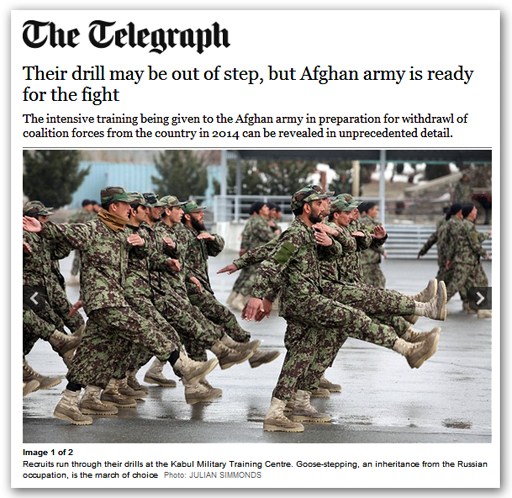
last post, we happen upon a piece of propaganda by defence correspondent Sean Rayment in
The Sunday Telegraph so inept, that one can only applaud the run of caustic comments.
Rayment bizarrely optimistic article about the Afghan National Army (ANA) thus attracts the comment from "ste045": "Was this article written by Army's PR corps, a larger dollop of wishful thinking I've yet to read".
From "anythinggoeshere", we get the view: "I doubt the raw Afghan military will have the competency or self confidence to be aggressive enough, they will probably adopt a bunker mentality", while "Carolus Campanus" tells us: "This piece is so wonderfully retarded that I may keep it so that I can have something to chuckle over when the Taleban take power".
Rayment actually claims the goose-stepping drill comes from the Soviet occupation, but "mackinlay" corrects him, saying that it "comes not from the Soviets, but, the German and Swedish mercenaries from the 1880s brought in to modernise the army". The current form of drill used, he says, "is straight out of the Swedish Army of the 1920s, with a Swedish military mission in the country from then to the 1950s".
This will not be the first time Rayment will have been wrong. While in June 2006, Booker was complaining about Snatch Land Rovers and calling for mine protected vehicles in Iraq, Rayment was
extolling the virtues of the Warrior.
For good reason then we have "MarcosPerez47" complain that: "The Telegraph has become a propagandist comic book even its most loyal readers can no longer swallow". Echoing this is "Fedupofallthis", who asks, "Is this article propaganda or tripe or maybe both? ", then adding: "Whatever it is, I am not swallowing it".
And then there is "tinkerbell23", who says: "From your headline: '...can be revealed in unprecidented detail' ÃâÃ⦠The subbing at the Telegraph is getting very bad now. It's getting to the point where there is not a single article on the web site version that does not have either an awful spelling error ÃâÃâ¦".
That error has been corrected now, but we still have "withdrawl", the second error, so far undetected. "More and more people read this paper on the web. If the web version is full of errors then it ruins that experience. Eventually, I'll stop reading it", says "tinkerbell23".
Behind the scenes though, we hear that the sub numbers have been slashed, leaving the staff quite unable to cope. And as always, it is the sharp end that suffers, although the paper still seems to have enough money to send Rayment to Kabul to pick up on the propaganda.
The clue here is that it is essential for the Cleggerons to project that the ANA is capable of taking the load, thus legitimising the withdrawal. And if Cameron needs the ANA to step up to the plate, Rayment will obligingly tell him it is "ready for the fight".
Actually, when I think about it, this time comments were relatively restrained...
COMMENT THREAD 11/03/2012
A little while back,
I drew attention to
a forum where some posters were being extremely unpleasant about me and
my new book, despite their not having read it. Independently, and in response to that blog post, a number of commenters joined the fray, building to over 300 replies on the single thread, with over 10,000 views.
That left the diehards getting more and more aggressive, and they tried to defend their turf ̉̉ until yesterday when the thread was removed it its entirety, apparently on the pretence that a thread about a book (started last April) is covert "advertising".
One has to gloss over the question as how one can discuss a book without in some way "advertising" that book, but such higher realms of logic are clearly not for the defenders of the faith, especially as advertising
is clearly allowed elsewhere.
What this is really all about, therefore, is the "guardians", having dictated that the Battle of Britain is the daylight battle for air superiority conducted by RAF Fighter Command from July to October 1940, no alternative viewpoint is permitted.
Ironically, the narrative attached to those who flew in 1940 to defend our freedoms must now be defended by restricting freedom of expression in a discussion about the value of their exploits. Doubtless,
Wing Commander H R Allen would have appreciated the irony.
The broader issue here though, is the point that I made in my
original post, when I remarked on the similarities between this bunch of obsessives and, warmists and even europhiles.
But what we see in them is also apparent in some of the comments to
Booker's column on armoured vehicles, where one sees the
same type of dogmatic, sneery and aggressive response that one encounters elsewhere.
There is nothing at all wrong with this approach when it comes to addressing our masters. But one really does wonder why some people feel it so necessary when they join anonymously forums and comment threads to express their views in such a way, to people whom they do not know and have sinned only in having views which differ from their own.
It is difficult to judge, without a comparative base, but one really does wonder if we are on the verge of a new era of intolerance.
COMMENT THREAD 11/03/2012 "

Having taken such a very great interest in the Snatch Land Rover saga, right from the very beginning, with an article in his column on
18 June 2006, it is hardly surprising that Booker should revisit the issue of inadequate armoured vehicles in
this week's column.
In fact, those six years ago, I held off publishing on this blog
until that date, in order to come out the same time, and thus Booker and I worked together on the issue, seeking improvements in equipment which would save lives.
Of course, measured against the scale of events which afflict so many, the recent deaths of six soldiers in Afghanistan was a relatively minor event. Even as I write, the deaths of 50 people
have been confirmed following an avalanche of snow, ice and mud "which buried the village in a disaster-prone area of northeastern Afghanistan where Mother Nature is a bigger enemy than the Taliban".
As far as we are concerned, though, the emphasis on the six does not suggest that their lives are worth any more than the fifty unnamed victims of avalanche. Rather, it reflects the fact that we, as a nation, have a special responsibility to our military.
Whether we agree or not with what they are ordered to do, they put their lives at risk in our name and we therefore must do whatever we can to reduce their risks, in whatever way we can. Booker and I, with column, blog, contacts and the support of readers, can do more than most but that simply means that our responsibility is greater.
And, as Booker writes in his column, the deaths of six young soldiers in Afghanistan were not just a tragedy they were the result of a catastrophic political and military blunder. .
He himself reminds us that it is six years since he first began reporting on how, first in Iraq, then in Afghanistan, our troops were not being equipped with patrol vehicles designed with V-shaped hulls to deflect the blast of roadside bombs, or IEDs, such as that which last week destroyed the Warrior in Helmand.
The first of these vehicles to become notorious was the Snatch Land Rover, 200 of which were sent to Iraq from Northern Ireland in 2003, with the approval of Sir Mike Jackson, then the head of the British Army.
Among the subsequent succession of fatal incidents involving Snatches was that which in 2005 killed three men, including Private Phillip Hewett. After Booker first wrote about this, on June 18 2006, our generous readers contributed ã7,000 to enable his mother Sue Smith and others to bring a successful High Court action against the Ministry of Defence. Their only aim was to publicise how indefensible it was to send troops on patrol in vehicles giving no protection against IEDs.
But this was only one of a series of similarly unprotected vehicles which the MoD, with the blessing of the Army top brass, persisted in deploying to Iraq and Afghanistan Vectors, Vikings, Wimiks and Warriors among them, in which more than 60 soldiers have died, 37 in Snatches, 28 in Warriors.
What made this particularly disturbing was that Britain had, until recently, been at the forefront of designing vehicles with the V-shaped hulls which proved so effective in minimising the impact of IEDs that other countries' armed forces, led by the Americans, were quick to adopt them, saving hundreds of lives. The first US-built vehicle was based on a British design.
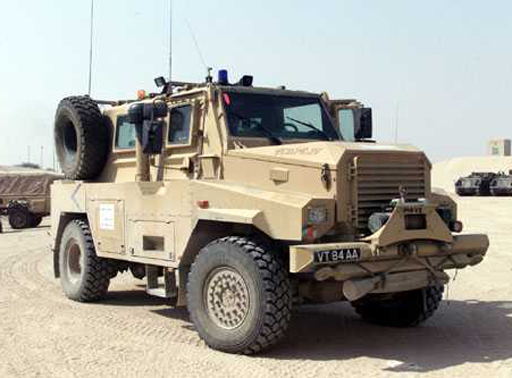
That British design was the
Tempest (pictured above) which replaced our mine-protected Mambas which in 2004 we had sold off for peanuts, including nine to Estonia which later operated in Afghanistan alongside British troops still forced to use IED-vulnerable Wimiks.
Bizarrely, in terms of mine protection technology, we were once the world leaders but since have
gone backwards, inexplicably surrendering our lead, first to Rhodesia, then South Africa and then the United States, from which we currently buy the vehicles on which the Mastiff and Ridgeback are based.
But what Booker reveals is that, in 2006, we were far from alone in our determination to bring better equipment to our troops. We managed to establish a hotline to the then Secretary of State for Defence, the much-underestimated Des Browne.
It was he, not the military, who grasped the problem, and who managed later that year to get mine-protected Mastiffs deployed to Iraq. But the Army, then under Sir Richard Dannatt, still insisted on equipping troops in Afghanistan with Vectors (dubbed "coffins on wheels") in which five men died with many more injured, before they were withdrawn in 2010.
Part of our problem, though, remains well-meaning but basically ignorant coroners. For instance, at a Wiltshire inquest in 2008 into the deaths of four soldiers, including 2nd Lieutenant Joanna Dyer, when their Warrior was blown up by an IED in Basra, the coroner criticised the vehicle's lack of "armour" against roadside bombs. But even he did not grasp that armour alone cannot provide the right kind of protection unless the vehicle is fitted with that all-important blast-deflecting hull.
Four years later the Army is still sending patrols into harm's way in the same unprotected Warriors, as we saw last week from the worst single incident of troops being killed on the ground in either Iraq or Afghanistan.
Meanwhile, the MoD is spending ã1 billion on upgrading the armour to Warriors, which will do nothing to protect them against roadside bombs (and will not be ready until 2018). So the tragedy continues. The Taliban, says Booker, surely cannot believe their luck that we British are so stupid.
The worst of it though is that it is probably
not stupidity but something much worse. And that is why, after all these years, this issue is as important now as it was when we first started writing about it. No lessons have been learned and, given a chance, the Army will dispense once again with mine protected vehicles, leaving troops once again to die.
This sadly, is an ongoing battle against our own Ministry of Defeat, the greatest enemy of us all.
COMMENT THREAD 10/03/2012
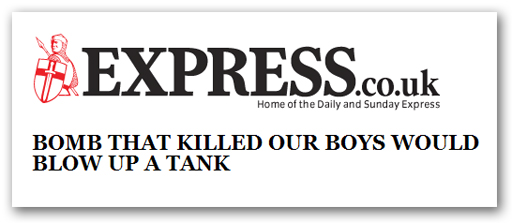
The bomb which killed six British soldiers was so massive that it would have threatened a battle tank, says CDS David Richards â as retailed by the
Daily Express. "Be quite clear", that this IED â which we are pretty certain it was â was massive and even a main battle tank that had been struck in that way would have had a problem", Richards claims.
But that, of course, isn't the point. As we
have observed, the comparison needs to be made, not with a tank, but with a
mine protected vehicle. The question to ask is whether, on balance of probabilities, a Mastiff would have survived the blast.
Making his comments, therefore, Richards is either being stupid or disingenuous. The man, however, has a reputation for being quite intelligent and, while high office does tend to rot the brain, one can assume that he knows his comparison is false. But in that case, the indications are that he is setting out deliberately to deceive.
The sadness is that, as far as the MSM goes, it is so easy to pull the wool over their eyes â not just on this issue but on so many others. It would have been so easy to have taken this statement apart â but, as always, the newspapers are not up to the job.
What troubles me though is that such inadequacies are not without their consequences. If the MSM challenged statements from the likes of Richards, the military might be forced to take real action to contain the threat. But, as long as it can get away with pulling wool over the eyes of the hacks, there is never any pressure to improve.
Furthermore, the officer(s) who wrongly tasked fighting vehicles to carry out routine patrols, and thereby share responsibility for the deaths of these men, are not in any way censured or corrected. Through the inadequacy of the media, therefore, the Army is allowed to perpetuate its own inadequacies.
COMMENT THREAD 10/03/2012
Let's face it, they don't make disaster movies like they used to: "What we are seeing now is that investors are shifting their focus to the next stage", says Valentijn van Nieuwenhuijzen, head of fixed income strategy at ING Investment Management.
No winners, says
WSJ - only lessons. And there are already more losers arising from its far-reaching ramifications, says the paper, hedging its bets. But, it ain't over yet. Bound and gagged, and stuffed in the boot of the colleagues' car â the fat lady is still very much there.
COMMENT THREAD 09/03/2012
It would seem odd to celebrate the resumption of sales of
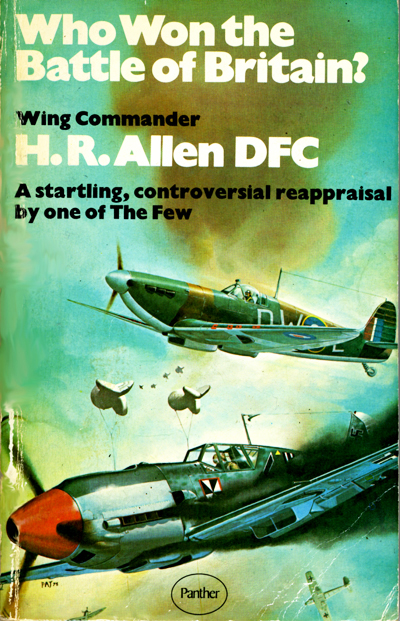
The Many Not The Few with an evaluation of a much older book (pictured) by Wing Commander H R Allen called
Who Won the Battle of Britain? First published in 1974, and unfortunately now available only in limited numbers as used copies, Allen - himself a Battle of Britain pilot - is scathing about the war leaders of his service, the RAF.
"It is doubtful", he says, "whether the professional neglect of the Air Staff as a whole in 1940 has ever been equalled in the long history of British arms . Strategic misappraisals, the lack of understanding of air power, dogmatically held incoherent theories, inflexibility of thought processes, crazy procurement policies and a lack of adherence to the principles of war".
As one reads with growing admiration this book, one gets the impression almost of a completely different battle to the one painted in so many more popular accounts, something to which Allen himself draws attention, writing (on p.204), following his own analysis of the battle:
Sadly, we arrive at the conclusion that the Battle of Britain has been glorified to the point of hyperbole by British historians.
This is written both generally and in the context of Hitler's threat of invasion, which Allen takes to have been a strategic bluff with no realistic (or any) prospect of success.
As to the air situation, he takes the view that had the
Luftwaffe defeated the RAF and Hitler had given the order for the invasion to be launched, it "would in all probability have been smashed" by the British Fleet.
"Without doubt the five hundred or so section, flight and squadron commanders in Fighter Command earned their laurels", Allen writes, "but the real victor was the Royal Navy, the Silent Service". He concludes: "In short, the truth about the Battle of Britain is that it was a silent victory".
For the day fighting phase, between July and September 1940, this entirely accords with my view, but I then extend the thesis to argue that the Germans, appreciating that the invasion was a non-starter, had already changed their
schwerpunkt.
The Germans bypassed the RAF by concentrating on night bombing, attacking the civilian population rather than the military - an early example of "shock and awe". The intention was to achieve regime change, in the hope that the new government would bid for peace.
It was that phase which, in my view, became the decisive battle for, had the morale of the British people broken, sustaining the war effort would have become impossible and Churchill - already under considerable political pressure - would have had no choice but to resign.
Allen does not explore this, which makes my book very different - even if we come to similar conclusions. But what the Wing Commander does do is point up the many inadequacies of the RAF and its leadership. Collectively, these make it clear that the survival of Fighter Command through the battle was more a matter of luck than judgement, in spite of and not because of its leadership.
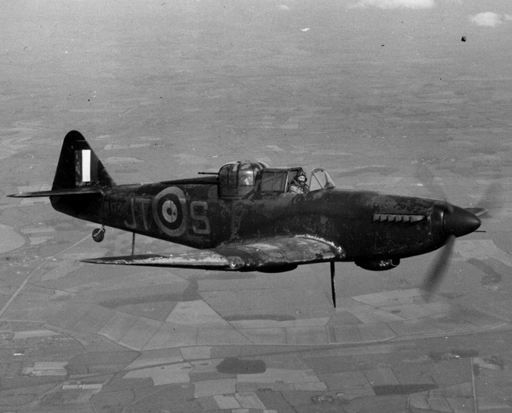
Why this is important, of course, is that we see mistakes of the 1930s and 40s being repeated again and again, right up to press. Allen talks about procurement failures in detail and, if you want an account of young men being sent needlessly to their deaths, you need to read his views on the deployment of Defiants on 19 July (type pictured above).
"To write operational specifications which would produce such an aircraft was bad enough", he says. "To attempt to use it in front line action was almost a criminal offence".
Bringing that
up-to-date, we ask: could such a thing happen again? And, reviewing the use of Warriors as patrol vehicles in a counter-insurgency environment, we could say that to write operational specification for that vehicle in Afghanistan "was bad enough". But, to attempt to use it in front line action is almost a criminal offence.
More than ever do we need to know our history, and understand it - as we are already repeating it.
09/03/2012
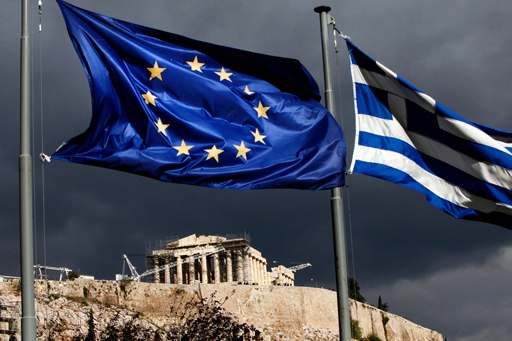
There are few certainties in life and one of them â as far as Greece is concerned â is not taxes. On the other hand, one thing that was certain was that the
life-and-death bond swap was going to pan out.
The investors will run it to the edge and then cave in, we said. Up to press, that is precisely what it looks to be. According to the
Financial Times late yesterday evening, investors holding more than three-quarters of Greece's [qualifying] private debt had agreed to participate in the swap, in what
The Age calls a "success".
Then, according to the
WSJ, a Greek TV station cited sources claiming more than 90 percent participation. That report has yet to be verified and Bloomberg reports a swap level of 85 percent. It
currently says that "preliminary indications" showed "as much as â¬155 billion ($205 billion) of the 177 billion euros of Greek-law bonds were offered". Reuters
now says Greece has averted the "immediate risk" of default (below).
In this, there is another certainty. This deal has been rigged. Ambrose
cites said Marc Ostwald from Monument Securities. He says, "The rule of law has been treated with contempt," adding: "This will lead to litigation for the next ten years. It has become a massive impediment for long-term investors, and people will now be very wary about Portugal".
Guessing (or even discovering) how is going to provide hours of harmless entertainment for those who have the wit and understanding to fiddle about under the bonnet, and examine the inner workings of the machine. It will also provide lucrative employment for innumerable lawyers.
To have predicted the outcome though, all we needed to do was listen and watch very carefully. Had we been so doing, we would have seen that the script had been written
last July. The fact of the matter is that is not Greece's time yet.
It will come in good time, but today the crisis will be parked. Tomorrow, of course,
is another day â but we don't have crises on Saturdays if we can help it. Monday, a new word can enter the lexicon - "redefault". Adjust your spellcheckers now.
COMMENT: "NEXT CRISIS" THREAD 09/03/2012
One can be
critical of the media for its inability to cope with the basics, but the fount of disinformation rests with the Ministry of Defence, the propaganda from which never varies. Thus, in response to criticisms about the level of protection offered by the Warrior, we get the current office-holder, Philip Hammond primed to sound just like his Labour predecessors six years ago.
Via
The Independent we thus learn that sock-puppet Hammond has "defended the level of protection offered by the vehicle", saying: "The Warrior is the most heavily armoured vehicle that we have. It has been very heavily upgraded following some criticism that was made of the level of protection by a coroner. That programme of upgrading has been completed".
Rightly he then says: "In fighting a war you can never be a hundred-percent protected. We don't know what happened in this incident - it looks like a massive IED that had a catastrophic impact on the vehicle".
But then we get the MoD propaganda, straight from the "line to take" briefing: "Obviously", says Hammond, "we will look at any lessons that can be learnt but talk to soldiers on the ground - they will tell you that there is a trade-off between level of armour and manoeuvrability. You can put more armour on a vehicle but then you make it slower and less manoeuvrable and that in itself creates risk".
Now go back to six years to
12 June 2006 and Labour's Lord Drayson defending the Snatch Land Rover. And, as we
found then, we get
exactly the same leaden argument. The "noble" Lord says: "We must recognise the difference between protection and survivability. It is important that we have the trade-offs that we need for mobility".
What is terrifying is that, in the MoD, they do think this way, and they really do believe what they are saying. Armour equals weight and weight restricts mobility. That is as far as their little brains can take them.
Not so very long ago I complained to a very senior MP (ex-minister) that the MoD seemed to have no idea of the five design principles for mine protection. I got back a plaintive e-mail asking: "what are the five principles of mine protection?".
Laboriously, I explained: distance; absorption; deflection; isolation and armour. In "distance", you have the front wheels as far ahead of the protective cell as possible, and mount the cell high up. The greater the distance from the blast, the less the effect.
Absorption means making frangible parts which blow off, absorbing energy and again reducing blast effect. Deflection is the v-shaped hull and "isolation" means preventing contact between the crew and the hull. In the best designs, the seats are suspended from the roofs of the vehicles, and the soldiers have foot-rests which keep their feet off the floor � thus preventing the shock being transmitted to them.
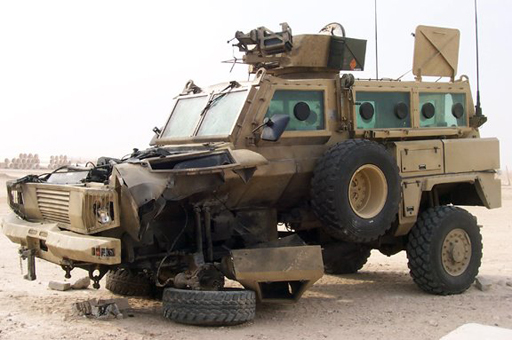
Last, and least then comes armour. And no amount of armour will protect if the other basic principles are wrong, or the armour is in the wrong place. By the end of the Iraqi occupation, the insurgents had learned how to take out Challenger and Abrams tanks. Yet the Cougars and Mastiffs, at less than half their weights, survived. In a 7-ton RG31, the crew survives (above) � in a 60-ton Challenger, they don't. The difference is design.
Technicalities aside, though, what this goes to prove is that ministers really are sock-puppets. Without brains or experience of their own, they are simply primed by their civil servants with the same old mantras. These, they spew out on demand, seemingly unaware that their predecessors, and those before even them, were spouting exactly the same mantras, with like effect.
You would think they might learn. But they do not.
COMMENT THREAD 08/03/2012
This one is getting
worn out.
ZeroHedge, however, might be
thinking otherwise, although in this case, I have to admit that I haven't the first idea what he is talking about, even after running through Google translate.
COMMENT THREAD 08/03/2012
There is much
discussion in the media, for once, about the fatal weakness of the Warrior, in having a flat-bottomed hull. If we have achieved anything over the last six years, therefore, it is to lodge in the public and media consciousness the merits of the v-shaped hull.
Nevertheless, one still gets the comments that, if you add armour, all that will happen is that the enemy will build bigger bombs. Well, indeed that is exactly what has happened yet, it is germane to note that despite this, not a single person has been killed in a Mastiff â not a single person.
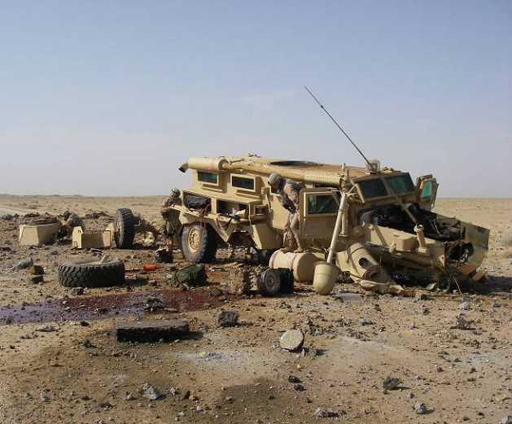
The reason is precisely because the v-shaped hull deflects the blast rather than trying to provide a barrier. Thus, when a Cougar, on which the Mastiff is based, was hit by a 100Kg bomb,
the crew survived (pictured above). By comparison, an anti-tank mine typically has seven kilogrammes of explosive.
However, when
in 2006 we sought to extol the merits of the v-shaped hull, the "bigger bomb" theorists were out in force, and I took a great of flak â especially from the "experts" on the
ARRSE forum.
But all of this debate seems to pass by certain sections of the media, as we get the likes of
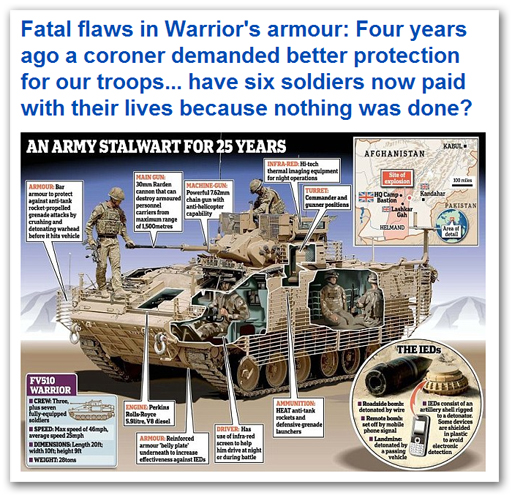
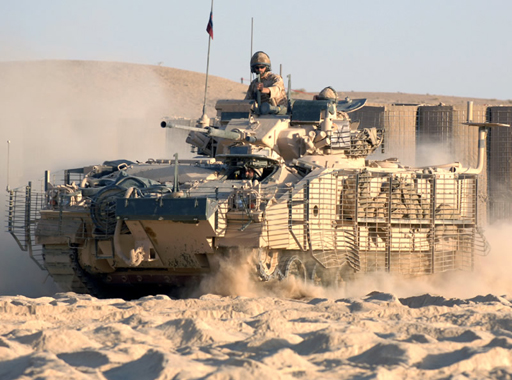
The Daily Mail calling for additional armour on the Warrior (pic below), heedless of the fact that mine protection must be designed in
ab initio. It cannot be bolted on.
Where vehicles such as the Warrior are deployed, therefore, protection requires a multi-faceted approach and, for all my many critics, it is worth recording that my
first sojourn into this field argued for better detection of IEDs, noting that extra armour was not the solution.
And, therein lies the problem with the Warrior. Add armour to the flat underside and you risk the
same fate as the Bradley in Iraq in 2007, which was
flipped over on its back by the force of an explosion, killing six soldiers and an interpreter.
The essential flaw with the Warrior and its deployment in Afghanistan is that a mechanised infantry
fighting vehicle (MICV) is being misused as a patrol vehicle. We had the
the same problem in Iraq but, just because
a coroner calls for extra armour, that does not make it the answer.
It is about time newspapers such as
The Mail learned something of the basics.
COMMENT THREAD 08/03/2012
With more "launches" than the Metropolitan Police river patrol, and as many different dates as Hitler's abortive invasion,
The Many Not The Few is finally "available" on Amazon on what is now supposed to be the official launch date. But can you buy it? Dear me no! From "not yet released" it is now "temporarily out of stock". I suppose that is progress.
On the brighter side, we are having an unofficial not-a-launch-party in the House of Commons on Monday 26 March, between 4-6 pm, when I will be giving a lecturette on the role of J B Priestley in the Battle of Britain. The meeting is open to readers (frustrated or otherwise) but by invitation only.
If you want to come to this not-a-launch, please e-mail me and I will get an invitation sent to you.
COMMENT THREAD 08/03/2012
This administration â bad by any measure â has plumbed
new depths in responding to a routine enquiry from SNP defence spokesman Angus Robertson, on the details of defence equipment based in Scotland.
The written answer from Lib-Dim armed forces minister Nick Harvey appeared to suggest that the number of aircraft based in Scotland had risen from 66 to 80, despite the closure of two of the three RAF bases north of the Border.
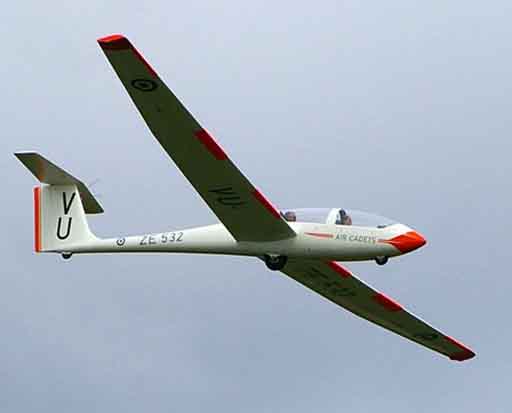
However, for the first time it was not specified whether the aircraft were Tornado or Eurofighter jets â and it later emerged that the MoD had included 13 gliders used for cadet training in the statistics â the first time this had ever been done.
The aircraft included five Viking cadet gliders at Kirknewton (type pictured above) and another five of the same model in Arbroath, as well as three Vigilant Power gliders based at Kinloss and Lossiemouth in Moray.
This really is getting seriously bad when the MoD is effectively including training gliders in the order of battle, although if the cuts continue it may well be that these aircraft find their way onto the front line. The impact on the enemy could be quite profound â with hundreds set to die laughing.
Worryingly though, the MoD probably wasn't joking.
COMMENT THREAD 07/03/2012
Is it very easy to draw a range of conclusions from the
Warrior incident, not all of which are consistent with each other or sustainable. Given the circumstances, some might venture that Taliban have only just worked out how to destroy a Warrior, in which case it would be valid to speculate on where the Taliban are getting the expertise to improve their IEDs.
On this basis, it would be quite logical to point the finger of suspicion at the Iran - the Islamic Republic's Revolutionary Guards Corps, which "is the regional expert in the development of weapons of this kind".
However, the Taliban have already twice taken out Warriors with fatalities reported. The first time was in
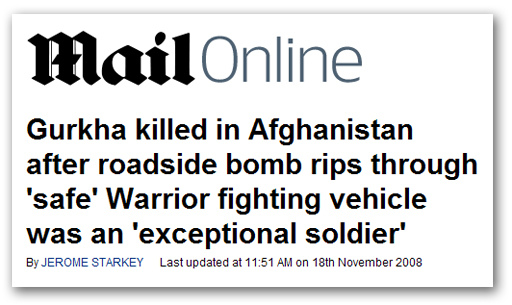
November 2008. That incident was then â nearly four years ago - considered by
The Daily Mail (headline below) to be "proof" that the Taliban were "turning to bigger and deadlier bombs targeted at British troops".
By then, the Warrior had been in theatre for sixteen months. In the previous eight months, the
Mail reported that at least three Warriors had been damaged "beyond repair", "as the Taliban bomb makers set ever bigger charges in British soldiers' paths." Out of a fleet numbering only fourteen, this was (and is) a high proportion.
Thus, there is nothing really new about this capability. Although there are suggestions that this current incident will make it essential to introduce new and expensive countermeasures to protect the remaining fleet, there is very little that can be done to the Warriors to enhance their protection.
The weapon of choice, the Ammonium Nitrate Fuel Oil (AFNO) bomb, is a formidable instrument. But it is very old technology and has been used for many years by the Taliban. At weights of up to 250Kg, used in culverts, it can have
devastating results.
As to countermeasures, rather than armour, surveillance and patrolling are the main
options. Certainly, there is only a limited amount that can be done in the way of adding armour protection to a design which is not optimised for mine/IED protection.
Much more could have been done in the past, but with troops scheduled to depart by 2014, there is little more that probably will be done over the next two years. But one does look askance at Dannatt's
comments, with him saying that the deaths of six soldiers were a matter of "great sorrow and sadness".
Had it been left to him, British troops would have been equipped with Piranhas, under the guise of FRES, with far greater slaughter than we have already experienced â as recounted in
Ministry of Defeat.
Iran, thus â in this case â is probably the least of our problems and we need to look a lot closer to home for their source. One of them, currently, is sitting in the House of Lords.
COMMENT: "WARRIOR DOWN" THREAD 07/03/2012
The GWPF are pulling their usual stunt of attempting to take "ownership" of an issue by commissioning
a new report , this one "revealing" not very many details about wind power that haven't
been said before ⦠many times (and sometimes better).
What these people do not seem to realise is that efforts to create "noise" are far more successful if you build on and extend existing work, rather than keep reinventing the wheel and claiming it all for your own. Not least, Google ranking depends not only on traffic levels but on the number and type of links. Thus, cross-referencing other work is an important way of building profile.
Despite this, you see "top dogging" in a wide range of fields, from Open Europe and its attempt to dominate the EU agenda, to Taxpayers' Alliance and others. They all do good work, but are dragged down by their own egos, and their attempts to own the agenda in every field that they touch. Nothing exists, nothing ever came before, until they "discover" it.
As a result, they treat the internet as a zero-sum game. Instead of capitalising on the synergy afforded by the media, developing a "conversation" which expands over time as more and more join in, they plop their offerings into the domain, which enjoy but a short half-life before disappearing.
The sum of the parts thus becomes
less than the whole, when the other way around could so easily have been achieved. When other sites are recognised, their authors tend to reciprocate with their own links. Those links are picked up by others, who often then pick up of the original work, passing on the message, which grows rather than diminishes. A stand-alone site, which makes itself out to be above the fray, will never benefit from this dynamic.
All of this suggests that the primary purpose of campaigning groups of this nature is self-aggrandisement. One suspects that winning the battles is by no means their main or even desired objective. And that may be one of the reasons why, very often, there is so little progress against enemies who seem to have a better grip of campaigning tactics than our own side.
COMMENT THREAD 07/03/2012
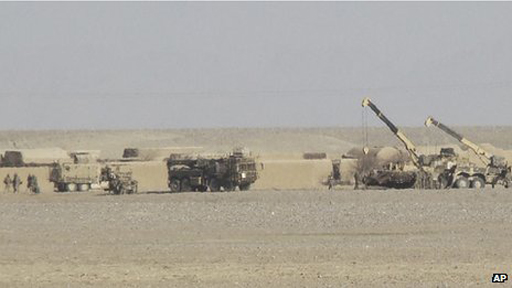
Six British soldiers were missing and believed to have been killed after their Warrior MICV was hit by an explosion while they were on patrol in Helmand, reports the
Reuters news agency.
The soldiers, five from the 3rd Battalion the Yorkshire Regiment and one from the 1st Battalion The Duke of Lancaster's Regiment, were on a mounted patrol when their vehicle was struck.
This brings the total number of British military deaths in the theatre since 2001
to 404, topping the 398 recorded on
13 February when SAC Ryan Tomlin was shot dead while on a routine patrol in the Western Dashte area.
This is the largest number of deaths from a single incident since September 2006 when 14 British personnel were killed in the crash of the Nimrod MR2, and is the most deadly single incident involving Army personnel on ground duties.
Given the significance the media attach to
century events, there must be a suspicion that the media-savvy Taliban have mounted a "spectacular" to maximise media impact, and thus the embarrassment for British political leaders.
If that was the case, then - from their perspective - they have chosen well. Although the Warrior is an impressive-looking vehicle, with considerable ballistic protection, it is
dangerously vulnerable when exposed to mines and IEDS, reflecting the
traditional reluctance of British military specifiers to incorporate such protection in their armoured vehicles.
For its precise role, however, there is nothing else that can provide its combination of off-road mobility and fire power, and it has been a
valuable attribute in so-called "kinetic" operations.
Unfortunately, the Taliban have shown themselves only too well aware of British vehicle vulnerabilities and, in this case, seem to have exploited the limitations of the Warrior to particularly deadly effect. The explosion occurred on the main Highway One, a tarmacked surface, so it was almost certainly a
culvert bomb of the type that gave our troops in Northern Ireland
so many problems.
The incident comes at a time when domestic political stresses are already preoccupying British leaders. This stark reminder of a "
forgotten" and unpopular war can only serve to reaffirm the political determination to pull out before the next general election.
COMMENT THREAD 07/03/2012
Sometimes, all you have to do is look at the
past aspirations (above), and then see
how it turns out (below). If a week is a long time in politics, twelve years is an eternity. There ain't nobody even thinking "superpower" any more ⦠and whatever happened to Blair?
COMMENT THREAD 06/03/2012
It is inevitable, I suppose, that when the
Reuters Institute for the Study of Journalism wanted someone to give the Reuters Institute/BBC David Butler lecture, focusing on the decay of democracy, they would go to someone in the political bubble.
That person was Peter Kellner, husband of EU "foreign minister" Baroness Catherine Ashton - and this is their choice of speaker to tell us about democracy? But then, the Reuters Institute boasts for its
advisory board Lord Patten, former EU commissioner, as its chair, and such notables as Alan Rusbridger, Editor in Chief of
The Guardian and Mark Thompson, Director-General, BBC. Its director is
David Levy, the controller of public policy at the BBC until 2007.
Howsoever, it came to pass that yesterday, the egregious Mr Kellner delivered his lecture, the full text of which is on the
Reuters Institute site, entitled "The Second Superpower".
The title came from
New York Times writer, Patrick Tyler who in February 2003, one month before the Iraq war, wrote that the huge anti-war demonstrations around the world this weekend were reminders that there may still be two superpowers on the planet: "the United States and world public opinion".
To an extent, the title is a red-herring, because Kellner goes on to say that world public opinion failed to stop the Iraqi war and that, while the eventual impact of people power will be immense, "right now it is still groping for institutional forms that can give it teeth".
Bizarrely though, Kellner did not seek to empower the people â the objective of a functioning democracy. Instead, he came to warn that representative democracy was in trouble, not just in Greece and Italy, or Russia and the United States, but "here in the United Kingdom". He argues that "our very system of democracy is more fragile than we like to think".
In fact, we do not have democracy, as such, but a system which now relies only partially on "representative democracy". But representative democracy isn't democracy at all, but the next best thing, devised for the times when it took days for a stagecoach to get to Edinburgh, there was no telephone and the internet had yet to be invented by Al Gore.
Then, says Kellner, representative democracy enjoyed a technical monopoly but now, under the assault of modern technology, mendacious journalism and angry voters, we are "drifting towards a political system" which "will undermine representative democracy". And this is, horror of horrors, direct democracy - with decisions made by the people using referendums.
Thus, very early in his lecture Kellner nails his flag to the mast. He is not there to defend democracy at all, but to protect the
status quo - representative democracy, the thing that isn't democracy at all - mounting a defence against that peril of all perils, the referendum .
To perform his task, he decides to frame the "core issue" in terms of legitimacy â whether people accept the principles of representative democracy. He then calls in aid his own polling organisation
to inform us that nearly two-thirds of voters (62 percent) believe politicians lie "all the time" and less than a quarter (24 percent) think parliament does a good job debating issues of concern to them.
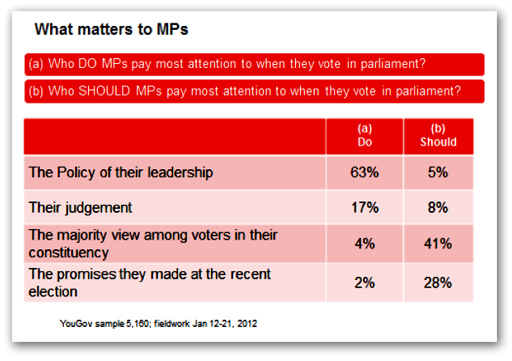
The biggest handicap though is that voters see MPs as servants of the party leadership, backed by a poll which also showed what people thought MPs should be giving most weight to their views.
It is because of this, Kellner argues, we see a growing clamour for direct democracy and the use of referendums. And, if a variety of issues were put to the vote, "Referendum Britain" would be a country outside the European Union, with no net immigration, a £1 million maximum pay limit and parents armed with the names and addresses of local paedophiles.
This, clearly, is not acceptable to Mr Kellner â or his backers (and, doubtless, abhorrent to his wife), so the man launches into an attack on the very idea of referendums. And, shorn of its rhetoric, this is what Kellner's lecture is really all about.
To be fair to the man, in identifying the problems with referendums, he makes some good points - not least that politicians, in deciding when, where and on what terms referendums are held, can use them as a tactical device to achieve their own ends. And with such arguments, he argues against direct democracy in general and their concomitant referendums as the basis for improving democracy.
Instead, Kellner, the pollster, wants better ways of measuring public opinion, and then urges MPs to engage more fully with it. Interestingly, though, he is very far from being the first to make such points. More than seventy years ago, in the pages of
Reynolds News, Prof A Berriedale Keith was writing in very much the same terms. Then as now, though, the problem is not so much the measurement of public opinion as getting MPs to take notice of it, and "not humbly to obey the bidding of the whips".
To that problem, Mr Kellner has no answers. Even though he does come up with ideas for improving the measurement of public opinion, he no more than Berriedale Keith, have any ideas as to how MPs can be forced to take note of public opinion. He ends up, therefore, with the incredibly lame suggestion that the public should have confidence in the
process by which governments and parliament reach their decisions.
The goal, he suggests, should be neither to surrender to the "second superpower" nor to ignore it, but to show that it is being listened to, seriously and with at least a semi-open mind, so that when MPs vote differently from the way their constituents want, they deserve respect for the way they make up their minds. Referendums, he says, can then be kept for those, hopefully rare, occasions when Parliament gets it totally wrong.
Such is a partial summary, which barely does justice to as lecture that runs to thirteen pages. But what is especially interesting is that Kellner says that, because they misuse them, politicians should be banned from calling referendums. Instead, the public should be given the power to wield a "people's veto" on any Act of Parliament or local council decision by gathering the signatures of ten percent of the electorate on a petition.
But, in coming out with ideas that were, in fact, being rehearsed more than seventy years ago, he does not acknowledge current ideas, particularly the discussions on the blogosphere where there is a healthy debate going on.
And, of course, he does not in any way acknowledge the concept of
referism, which offers the ultimate "people's veto" in allowing the people to block the budget. The likes of Kellner are far to grand to sully their precious minds with other people's ideas. Thus, whatever else we have here, this is not a democrat speaking. This is a man who wants to keep people away from power, and to reinforce the status quo.
COMMENT THREAD 06/03/2012
Taking a break from his prolonged break (in blogging),
Klein Verzet brings us a "bit of news" â
a report, he says, that "will blow up the eurozone".
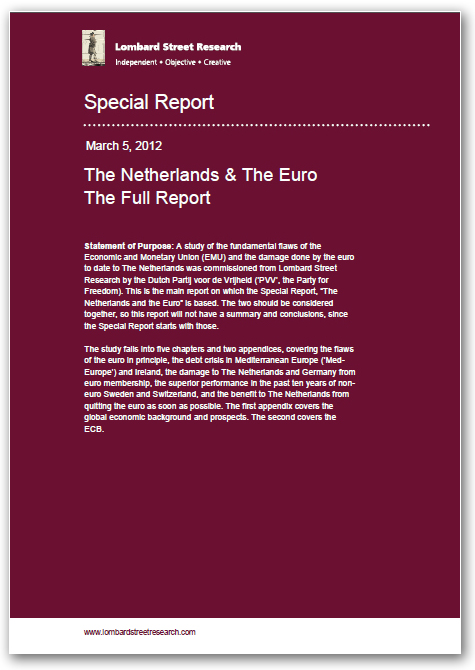
This shows that the Netherlands would benefit financially from leaving the euro and returning to the guilder (75-pages available
here). It was commissioned by Geert Wilders and produced by Lombard Street Research.
The bottom line is that the euro has damaged the Netherlands' prosperity. For example, the Dutch economy has grown an average 1.25 percent per annum since the euro was introduced, compared with three percent each year in the twenty preceding years.
Yet over the past ten years, the economies of Sweden and Switzerland, which are not members of the eurozone, have grown 2.25 and 1.75 percent respectively, the report states.
Leaving the euro now will cost up to â¬51 billion, but that would be more than offset by the â¬75 billion saved by not propping up the single currency, Wilders says. Predictably, he wants a referendum on the issue â which, of course, will not happen in the foreseeable future, as it might give the "wrong" result.
COMMENT THREAD 05/03/2012
Despite the no-expense-spared
run of clichés, it looks as if the "colleagues" aren't even going to give us a decent crisis for our money. At least, that would be the conclusion if we take at face value the
New York Times, along with the
Financial Times and several others.
In the words of the
NYT, Greece moved a step closer to avoiding default when the Institute of International Finance, the global banking group that represents major private-sector holders of Greek debt, said that twelve members of its steering committee would take the haircut.
However,
ZeroHedge immediately put a damper on that, telling us that the steering committee only holds about 20 percent of the private sector bonds that are involved in the debt swap. That means, says
ZH that a whopping 80 percent of the bonds are unaccounted for, and more importantly, "it means that the likelihood of a major blocking stake having organised is far greater than even we expected".
Nevertheless, with even the
Wall Street Journal sounding bullish, we might only have to let a few more clichés run to the wire, before the game is over and the man in the white hat rides off into the sunset.
COMMENT THREAD 05/03/2012
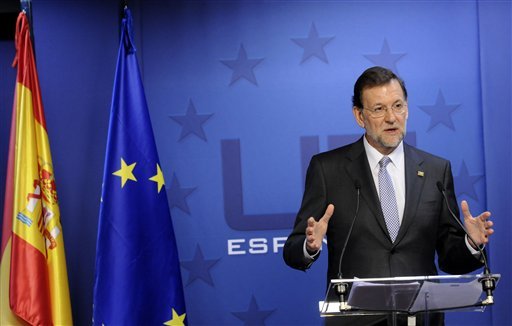
One is just a tad surprised by the surprise expressed over Mariano Rajoy's surprise announcement about the Spanish deficit last week. That is because, if one recalls what the prime minister
was saying at the end of February, it should not have come as a surprise.
Anyhow, even if the
Financial Times was surprised when Rajoy said that Spain was going to breach its budget target for the year, that is nothing to what Ambrose
is calling it - no less than a "thunderclap".
But, it seems, it is not only
what Rajoy has done, but the
way he has done it â or, to be more precise â what he
has been saying. Bearing in mind that the "colleagues" had just signed their fabulous
new treaty, taking the eurzone closer to fiscal union, up pops Rajoy and says: "Democracy, national sovereignty and dignity of the states and their citizens in a democratic Europe that is said is much more important than the supposed 'fiscal union' of the EU".
This is as close to farting in church as it gets, and what Ambrose finds striking is the wave of support for Mr Rajoy from the Spanish commentariat. One from Pablo Sebastián, he says, left me speechless.
"Spain isnât any old country that will allow itself to be humiliated by the German Chancellor," he writes â as loosely translated by Ambrose. "The behaviour of the European Commission towards Spain over recent days has been infamous and exceeds their treaty powers ⦠these Eurocrats think they are the owners and masters of Spain".
"Spain", he continues, "and other nations in the EU are sick and tired of Chancellor Merkel's meddling and Germany's usurpation â with the help of Sarkozy's France and their pretended 'executive presidency' that does not in fact exist in EU treaties".
There is then reference to the behaviour of the EU commission to Spain in recent days being "infamous" and "exceeded the powers granted to this institution to the Treaties", and a complaint that the Eurocrats are acting "as if they were owners and lords of the Government of Spain".
Thus does Sebastián say: "Rajoy must not retreat one inch. The stakes are high and the country is in no mood to suffer humiliations from a Chancellor who is amassing all the savings of Europe and won't listen to anybody, as if she were the absolute ruler of the Union".
"Merkel and the Commission should think hard before putting their hand into the sovereignty of this country â or any other â because it will be burned and the citizens are not going to consent".
This then is the fermenting mood in the fiercely proud and ancient nation of Spain in Year III of depression, probably the worst depression the country has seen since the 1640s, says Ambrose. And he sees in this trenchant comment the awakening of the Latin Bloc â and the end of Merkel's Europe.
If that is the case, it really would be something.
COMMENT THREAD 05/03/2012
The Independent, to its credit, conveys
the condemnation by Nassir Abdulaziz Al-Nasser, the 66th elected president of the UN General Assembly, of his own organisation.
The United Nations, he says, "must urgently reform to stay relevant in a world facing unprecedented conflicts and is not fit for purpose", and that "the ability of five countries to veto Security Council decisions was no longer credible and the outdated system was endangering international peace and security".
Al-Nasser is treading on dangerous ground here, as it is the veto which makes the difference between an intergovernmental organisation and a supranational government. It was the lack of veto in the League of Nations which led Jean Monnet to look for an alternative structure, and the emergence of qualified majority voting, on which the EU largely depends.
Whatever the current limitations, the prospect of a UN constructed on the same basis as the EU is not a road down which we want to go. Therein lies another major step towards the establishment of a world government.
Such considerations actually beg the question as to what the UN is for. Al-Nassar is looking at the organisation in the context of its traditional peace-keeping role, but as Dellers points out in his book
Watermellons, there is far more to the UN than this.
In fact, it is through subsidiary bodies like the
UNEP, the
UNFCCC and the
IPCC, that the real power of the UN is exercised, making the traditional peacekeeping operations a minor part of the total operation.
Via
Watermellons we actually get a very much clearer idea of where the UN is headed, with its grandiose and sinister ambitions for world governance. Whether, with his call for the abolition of the veto, that casts Al-Nassar as a useful fool, or a Machiavellian plotter, is moot, but the one thing we really cannot afford is a UN without that veto.
However, we can agree with Al-Nassar that the UN is not "fit for purpose". Perhaps, then, the more important question is whether we can (or should) afford a UN at all, or whether we should abolish it entirely.
COMMENT THREAD 05/03/2012
Well, the "colleagues" are not to be denied their crises, with another one set up for this week. This is, according to
The Financial Times and other media sources, Greece on another cliff edge â if a country can be said to be thus poised.
With weary constancy, we are told it faces yet another "decisive week" in its struggle to avert a sovereign default â this time the "planned debt swap". The
FT has it poised not on a cliff edge but a knife-edge â which, in terms of helpful clichés, means much the same thing. I suppose it is even possible that one could be poised on a knife edge as one falls over the edge of a cliff.
The proximate cause of this current crisis is "doubts" over the level of participation by private bondholders. At least 75 percent must "volunteer" to partake in a form of ritual slaughter known as the "Collective Action Clauses" (CACs), where private holders of â¬206 billion in Greek bonds have until Thursday evening to decide whether to take part in a swap.
The word "swap", of course, is another of those clichés â and may also be a euphemism. It requires the bonds to be traded for a package of bonds and cash that will knock about â¬100 billion off Athens' debts. This is known as a "haircut", even though the scissors are applied somewhat below the neckline - more like Shylock territory really, only think kilogrammes (plural).
The 75 percent figure was one which was inserted retrospectively into the bond conditions, but the "drop dead" figure is 66 percent. If less than that number participates, the CACs become invalid ⦠end of deal and civilisation as we know it, not with a whimper but a CAC (failed).
However, in an "cliché-rich environment", we have been marched to the top of the hill and down again so many times that one just knows that we are going for yet another long march. The investors will run it to the edge and then cave in. After all, what is â¬100 billion between friends, when the end of the world is at stake?
The last word, though, must go to an "insider" who says, "we are going to be flying blind for a few days". A piece of cake, as they say, to use up another from our inexhaustible stock of clichés.
No cliché has been harmed in the writing of this post.
COMMENT THREAD 04/03/2012
It would seem that I have under-rated the earth-shaking importance of Roger Helmer
jumping ship to join UKIP, giving it only the briefest mention in
an earlier piece. However,
Autonomous Mind makes some of the
necessary observations â having outed the man in the first place - while Roger himself gets the chance to explain on the
Tory Boy Blog.
The event of Helmer's defection is celebrated by
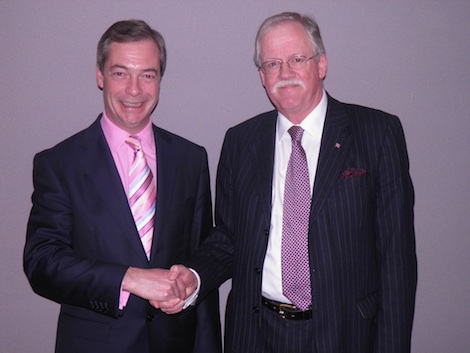
a photograph of an apparently smiling Farage, locked in a Masonic handshake with the Helmer (click also the photo above). But look closely and you can see the dead eyes, and gritted teeth.
This possibly because the very thought that has occurred to
Your Freedom and Ours has most certainly crossed Farage's mind. Given the size of the two egos, it is unlikely that both could survive in the one party.
With the help of a little bit of photoshop, therefore â amateur but good enough for the purpose â I have reproduced the happy group photograph (above right), modified to represent how Helmer most probably sees his role in UKIP. Two go in, but only one is going to come out.
COMMENT THREAD 04/03/2012
Following up on my earlier piece
on circuses, Booker
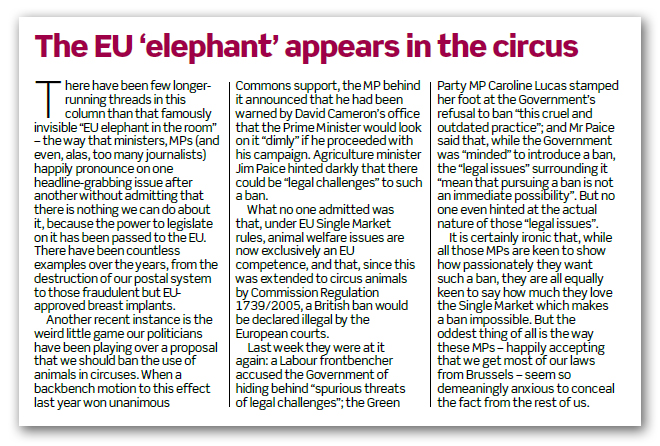
today notes that there have been few longer-running threads in his column than that famously invisible "EU elephant in the room".
This is the way that ministers, MPs (and even, alas, too many journalists â says Booker) fail to admit or explain that some controversial policy or law stems not from our own government but from "Europe" and we are therefore powerless to change it. There have been countless examples over the years, from the destruction of our postal system to those fraudulent but EU-approved breast implants.
This, in my view, is an extremely important phenomenon: people are being deliberately shielded from the impacts of our supreme government in Brussels, to which our provincial government is increasingly subordinated.
Interestingly, though, the circus example, although one of the more egregious examples, evoked absolutely no comment on our forum, and very little in the comments to Booker's own comments, which long seem to have been hijacked by a bunch of obsessive climateers â with only a couple of comments on the circus piece.
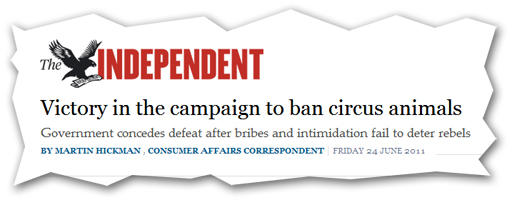
Despite that, the circus issue is special, not least because the indications are that the government set out deliberately to deceive. And newspapers such as the
Daily Wail seem to have bought the spin, announcing that the government was intending to ban circus animals.
On in later versions of the story in
The Independent did it emerge that the government had made no commitment to a ban, simply leaving it as a vague aspiration, with no firm date offered for when a ban would be implemented.
Cameron was thus accused of deploying "smoke and mirrors" to avoid imposing an immediate ban on wild animals in travelling circuses (above), while Tory MP Mark Pritchard, who had been leading the campaign for a ban dismissed the announcement as "disingenuous".
"Without a proper commitment to legislation in this Parliament", he said, "any claim to be listening to the will of Parliament is meaningless. This is a classic smoke-and-mirrors tactic by Number 10. Meantime animals continue to suffer".
Not once did any of the reporters, the government, nor in any of the published comments, was the EU dimension mentioned, although â as
Witterings from Witney observes â EU activity continues apace.
In this affair, a possible explanation is that animal welfare is a highly emotive subject, and the fact that the UK is being prevented from adopting a ban is potentially very damaging to the EU, hence the reluctance to publicise the EU role. Even the Commission seems wary of admitting its role, forcing the
EU Ombudsman to take a hand.
All the same, one really does wonder whether ministers are fully informed. In this case, we are dealing with Defra minister Jim Paice. He is not exactly famed for his intellectual accomplishment, to the extent that some have thought to applaud him when he successfully strings together three words to make a sentence without civil service help.
Certainly, there is the most profound ignorance within the Tory ranks on the role of the EU, evidenced by the recent comment on the fate of Cameron's top aide Steve Hilton. He is regarded as "one of the most imaginative brains in the Conservatives' high command", whose ideas have included scrapping maternity leave, suspending consumer rights legislation
But we are now told that Hilton has been
driven out by Europe, after becoming "increasingly frustrated" by the slow progress of the battle against red tape and the endless meddling of Europe in British politics.
As an aside, it is very easy to be "imaginative" in terms of policy ideas, if one has little or no idea of how government works, or the constraints upon it, but if Cameron's top aide is seemingly unaware of them, then the idea of government ministers being equally unaware is not that untoward.
Thus, even now the question of whether ministers are deliberately setting out to deceive, or are just pig-ignorant, remains an open question. I tend towards favouring the latter, but you can never be sure.
COMMENT: "POTENTIAL LEGAL OBSTACLES" THREAD 04/03/2012
Evidence that we are winning the "climate wars" is not hard to find, in the sense that the balance of the argument is tilting in favour of the sceptics. But, as I have pointed out on numerous occasions, were are dealing with the regulatory aftermath, which is the longest and most damaging phase of a scare.
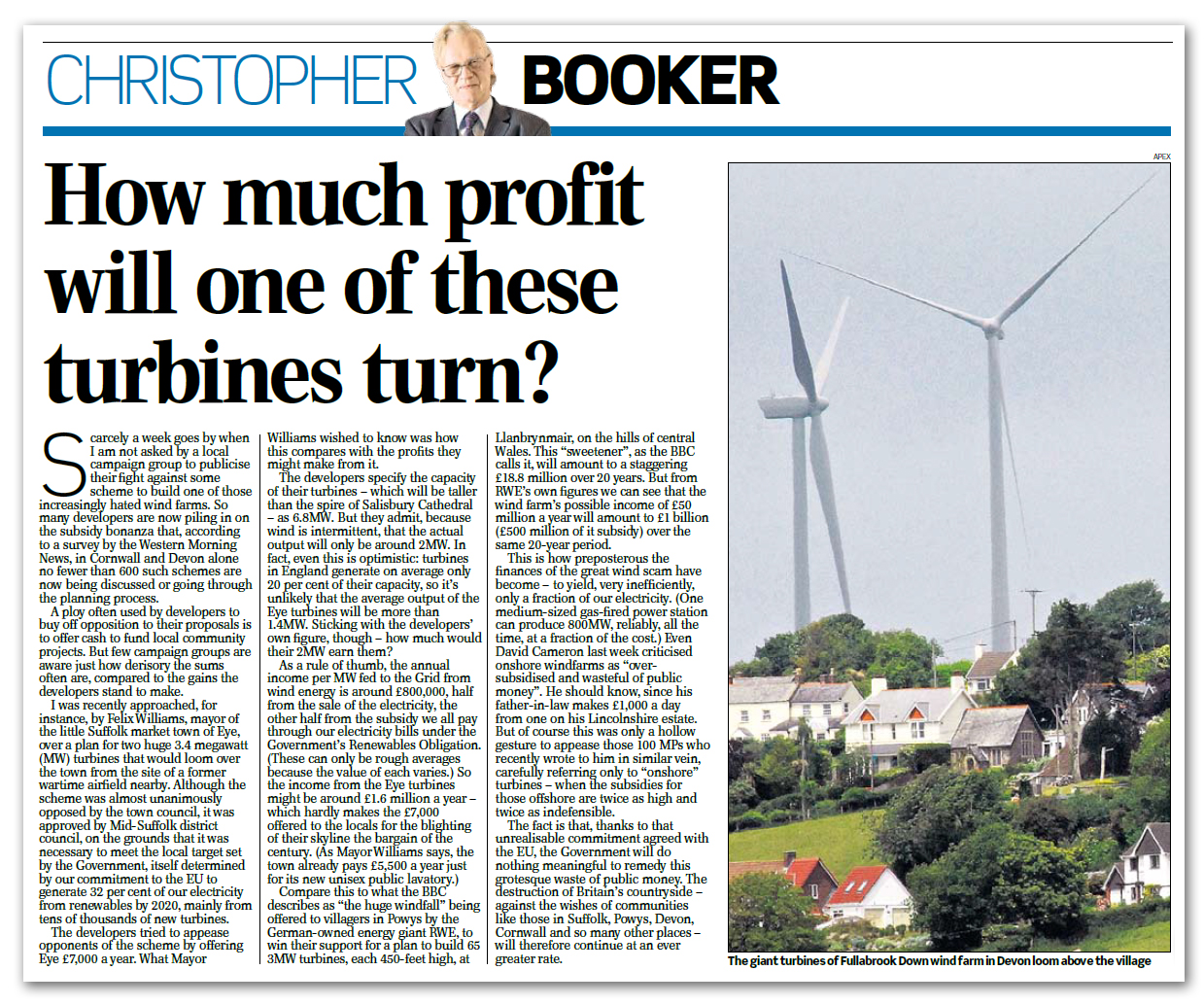
The effects are not always visible but, sadly, that is not the case with one particular consequence of the global warming scare â the rush to build wind factories. And so it is that Booker
this week has chosen to feature the subsidy bonanza that the wind developers are seeking to exploit, often against the wishes of local communities.
But Booker also informs us of a particularly insidious ploy used by developers to buy off opposition to their proposals, offering cash to fund local community projects, as a form of bribe. At first sight, there sometimes look quite generous but few campaign groups are aware just how derisory the sums often are, compared with the gains the developers stand to make.
This is the case with the proposed construction of two 3.4 MW turbines near the Suffolk town of Eye, for which local residents are being offered a bribe of £7,000 a year, yet the income from the Eye turbines might be around £1.6 million a year.
Other so-called "sweeteners" are just as derisory. For instance, the German-owned energy giant RWE is offering to villagers in Powys a staggering £18.8 million over 20 years to win their support for a plan to build 65 3MW turbines. But that wind farm's possible income of £50 million a year will amount to £1 billion (£500 million of it subsidy) over the same 20-year period.
As a rule of thumb, the annual income per MW fed to the Grid from wind energy is around £800,000, half from the sale of the electricity, the other half from the subsidy we all pay through our electricity bills under the Governmentâs Renewables Obligation. Thus, villagers are being bribed with their own money.
While the absurdity using wind as a means of generating electricity is gradually percolating into the public consciousness, with even some MPs expressing carefully tailored reservations, thanks to the unrealisable commitment agreed with the EU to reduce CO2 emission, now embodied in UK legislation, the government will do nothing meaningful to remedy this grotesque waste of public money.
That is the classic effect of the regulatory aftermath, and a graphic example of how we are
winning the battles and losing the war.
COMMENT THREAD 03/03/2012
The
Daily Wail is back on the case today, telling us that the EU is "an unaccountable, undemocratic institution" (above).
But if that is the case, why is it the paper's
editorial position is for the UK to remain in the EU (above)? Are we missing something?
COMMENT THREAD 03/03/2012
The book is finally on sale. You can buy it
here for £12.99 or, grab a
used copy for £1,179.86 â I kid you not. I would be hard put to deny that the latter price reflects its true worth, but I suspect that UKPaperbackshop is not going to sell many books (and they charge postage and packing).
UPDATE
Having decided the book was for sale (and having delivered most-pre-orders today, Saturday), Amazon has now decided that the book has not yet been released has thus reverted to "pre-orders". What has probably happened is that Amazon has run out of stock and, since the book is not officially launched until 8 March, the computer has reverted to "not yet released". In the meantime, the overall ranking went briefly to 854, and the book holds its No. 1 ranking in Battle of Britain books.
COMMENT THREAD 03/03/2012
First you have
this (above), reported on 14 September 2009 - " ⦠effectively a new interpretation of the European Working Time Directive".
Then we have the
usual ritual (above) of a man pretending to be a British prime minister, calling for a cut in "Europe red tape" â this one on 26 January of this year ⦠but it could have been yesterday â¦
as indeed it was.
Then, for the final act in the play, we have
this (above): implementation of the original ECJ judgement, bringing with it more red-tape and costs to business and the hard-pressed taxpayer â making The Boy to be the powerless fool that he is.
New regulations will be introduced in October and the government estimates that they will cost employers more than £100 million annually.
Strangely, the
Failygraph reports that: "Ministers claim that the new regime must be introduced following several European legal judgements". "Ministers
claim"? That is odd phrasing, for something that
could be checked - but at least there is a mention of "Europe".
And so the charade goes on, year after year after year, while little Timmy on the
Tory Boy Blog prattles that: "The Conservative Party remains the best hope for Eurosceptics". At least Helmer has had enough - he's resigned from the Tory Party.
COMMENT THREAD 03/03/2012

It was already obvious that, two years ago, the German policy on feed-in tariffs for electricity generated from photovoltaics was in trouble. With a tariff eight times higher than the wholesale electricity price at the power exchange and more than four times the feed-in tariff paid for electricity produced by on-shore wind turbines, it clearly could not last.
Cuts were already in the works and, over the last three years, subsidies have been slashed by up to 50 percent. But, says environment minister, Norbert Röttgen, the incentives are still too high.
So it is that the Germans are again cutting subsidies, this time by a further 30 percent, in a plan which, according to David Wedepohl, spokesman for the German Solar Industry Association, " amounts to nothing less than a solar phase-out law".
With the feed-in tariffs established in 1991 by the Electricity Feed-in Law, that makes it just over twenty years for the madness to work its way through the system, and now that the generators are embracing coal in a big way, it looks as if the greenie spell is being broken.
This is coming not a moment too soon for, even last week, Spiegel was complaining that rising energy prices were endangering German industry. It had Hans Heinrich Driftmann, president of the Association of German Chambers of Industry and Commerce, saying that energy supply was now "the top risk for Germany as a location for business".
Bernd Kalwa, a member of the general works council at ThyssenKrupp, was also cited, warning that: "Some 5,000 jobs are in jeopardy within our company alone, because an irresponsible energy policy is being pursued in Düsseldorf and Berlin".
In the run-up to German general elections in 2013 and prior to state elections, Kalwa and his colleagues plan to march into party meetings and ask how the candidates intend to regulate the energy supply in Germany in a cost-effective and reliable manner.
That seems to be making the difference. Unlike the UK, energy is going to be an electoral issue, and one which the politicians cannot afford to ignore. However, according to The Guardian, the greenies are also set to fight back, with thousands of demonstrators planning on Monday to gather at Berlin's Brandenburg Gate to protest under the banner, "Stop the Solar Phase Out".
To whom the federal and state governments listen will be interesting to see.
COMMENT THREAD
02/03/2012
Despite its interest
in such matters, and its concerns about
third-world corruption, strangely absent from the pages of
The Guardian is the
recent news of what appears to be a major embezzlement scandal involving the WWF in Tanzania (pic - the air conditioned offices in Dar es Salaam).
Approximately $1.3 million in cash seems to have gone missing from a project called "Strengthening Capacity of Environmental Civil Society Organisations". Overall, it was worth about $4.5 million, part-funded by Norway. Further funding has been suspended for this and for the $2.5-million REDD+ readiness project, aimed at "enhancing Tanzania's capacity to deliver data on forest carbon stocks", has also been put on hold.
As the news of the scandal emerged, WWF's Tanzania country director, Stephen Mariki, resigned and, so far, the eight people linked to the fraud have had their employment terminated.
This is not the first time the REDD+ project has attracted unfavourable publicity, with reports
last November, with complaints of evictions and that paddy rice farm huts had been torched and coconut trees felled in the Rufiji Delta mangrove forest reserve, where WWF has been operating.
WWF are seeking to reduce dependence on rice farming in the mangrove forest reserve and are encouraging Rufiji Delta communities and earn their living by other means, with the support of REDD payments.
The programme has been criticised by Betsy Beymer-Farris and Thomas Bassett, respectively assistant professor at the Department of Earth and Environmental Science at Furman University in South Carolina and professor, and the Department of Geography at the University of Illinois.
The pair have said that stopping the local tribes from cultivating in the delta is counterproductive, and censures WWF researchers and government authorities for trying to stop them from surviving by using resources in the delta despite their existence for centuries.
In the currently scandal, an external auditing firm, Ernst & Young, has been brought in to carry out a detailed audit and investigation of the projects, and WWF has undertaken to pay back to the government of Norway any funds that have disappeared.
The Ernst & Young report
was supposed to have been released by mid-February, but no details have so far been announced even though
it is said that Britain's Department for International Development (DFID) is eagerly awaiting the outcome.
Britain, through WWF UK, are the main sponsors of WWF Tanzania whose patron is Prince Charles. DFID works with WWF UK "to provide flexible and strategic funding for development work across the world". It is in close contact with the Royal Norwegian Embassy on the issue.
The
total income of WWF UK in 2011 was £55.7m (2009/10: £54.3m) and total expenditure was £56.6m (2009/10: £48.2m), of which membership and donations from individuals amounted to £28.7m (2009/10: £24.9m). The members may have to dig a little deeper this year.
COMMENT THREAD 02/03/2012
Well, the treaty that was so skilfully "vetoed" by The Boy in December has now been signed by twenty-five leaders of EU member states in Brussels
today.
This is what the "colleagues" are calling the Treaty on Stability, Coordination and Governance. It is aimed at strengthening fiscal discipline and introducing stricter surveillance within the euro area, in particular by establishing a "balanced budget rule". Cameron must be so pleased he was able to stop it in his tracks.
Such an event would not be complete without a little homily from
van Rompuy, who told the chaps that the treaty constituted "an important step in re-establishing the confidence in our Economic and Monetary Union".
No doubts are allowed to cross the path of the revered council president, who then gravely informed the world that "the restoration of confidence in the future of the Eurozone will lead to economic growth and jobs". That, he said, was the "ultimate objective".
The signing was on the first day of the spring European Council, which traditionally deals with economic matters, although the massed ranks of the media still insist on calling the meeting a "summit", demonstrating yet again that none of their commentary can be taken seriously.
The meeting also marks the re-appointment of van Rompuy as president of the European Council for a second "mandate" of two and a half years. The "Euro Summit" has also designated him president, for the same period.
Said Rompuy, on accepting the extension of his £249,000 a year post: "... The word 'Europe' has long been a sign of hope, embodying peace and prosperity. In the wake of the crisis this equation has come under stress. It is my, and our, role to make sure that Europe again becomes a symbol of hope. Of a better future for all".
Meanwhile, The Boy
seems to be bitching that the "colleagues" are "ignoring his proposals to tackle its debt crisis by cutting red tape to free markets and unleash economic growth". But he should hardly be surprised. Since the
acquis communautaire is at the very heart of The Project, proposals to cut it back are about as welcome as plans for building a new Israeli embassy in Mecca.
On the broader front, there are nine days left for the completion of the Greek debt swap, leaving
Jeremy Warner struggling to catch up with recent events. But again, we see a reference to a
European Marshall Plan, which provides yet another clue to the longer-term intentions of the "colleagues".
Whether Warner likes it or not, the current strategy is to flood the PIIS (PIIGS minus Greece) with money, and to isolate the Greek economy, prior to cutting the country adrift in the autumn, when the spin will be focused on the new rescue plan which will restore Greece to economic prosperity.
Gradually, the pieces are falling into place and, if the euro can survive past the summer, my gut feeling is that they might just get away with it for the time being. And, for the "colleagues", that is all that really matters. Tomorrow is always another day.
COMMENT THREAD 02/03/2012
This is all over the media, with the
Financial Times reporting that there is 200 years-worth of shale gas in China.
The announcement really is a game changer. The Agenda 21 pushers are now going to find it increasingly hard to run with "sustainability" and, with climate change running out of steam, we can see them struggling to create another scare which will have anything like the impact.
This also has important knock-on effects for Europe, as it will in due course relieve competitive pressure for supplies from Russia and its partners. Prices are undoubtedly going to ease, and it is going to be harder still to argue that renewables are ever going to be cost-effective.
And although it is early days yet, as the gas supplies become more plentiful, we will see wind become less and less attractive. Politically, it is no longer sustainable. The reality has to catch up soon, although one can see the vested interests attempting a rearguard action.
Within the decade though, my guess is that we will be looking back to this time as the point when the current suite of scares started to fall apart. I suppose we could say they are dead scares walking.
COMMENT THREAD 01/03/2012
Autonomous Mind directs me to a superb
ad hominem attack in response to his
recent post, allowing me, just for once, to cap him by referring to a lengthy
forum thread, largely devoted to personal attacks, directed at me as author of
The Many Not The Few.
Some of the most vitriolic condemnation comes from another author, Andy Saunders, a man to whom I bear no malice and who has written some tolerably good books in his time, not least
Convoy Peewit 1940: The First Day of the Battle of Britain , which I have referenced in my own work.
Yet it is Saunders, without having read
The Many (and nor could he as it does not become available until next week), condemns it as "utter tosh", describing me as "the chief bunkum-monger", at the same time imperiously declaring that he has, "no interest or intention of entering into e-mail communication with North". (Not Dr North ⦠but "North").
With others declaring that the book "sounds like complete attention seeking rubbish", not for the first time does it strike me that there is a parallel between the Battle of Britain and the obsession with climate change.
In particular, in Saunders's extreme and personalised response is so similar in demeanour to
AM's critic that one immediately looks for commonalities, and indeed there is one of considerable relevance: they are both defending their respective orthodoxies.
In Saunders's case, this is evidenced by
his long post, defending the central tenet of the Battle of Britain mythology â that Fighter Command won the battle - which rests on three points: one, Hitler intended to invade Britain; that, successfully to invade the island, air superiority was required; and that Fighter Command deprived the Germans of that air superiority, thereby preventing the invasion.
He and others take particular offence to my suggestion that Hitler had no great desire to invade and thus conquer Britain (but merely wanted to secure his western flank, paving the way for his invasion of Russia), and that the invasion threat was, by and large, a huge bluff.
In support of his argument that the invasion was intended, Saunders calls in aid "Führer Directive No. 17, issued on 1 August 1940": "In order to establish the necessary conditions for the final conquest of England" (I think he actually means Directive 16, issued on 16 July). This is seen as proof positive that Hitler intended to invade, that that necessarily, but for the intervention of Fighter Command, the invasion would have taken place, with the subsequent defeat of Britain.
Without dwelling too long on issues dealt with at length in my book, one can take note of another book, which I am currently reading:
The Politics of Nonviolent Action by
Gene Sharp, a useful addition to the library of any would-be revolutionary.
Sharp tells us that, "An error frequently made by students of politics is to view political decisions, events and problems in isolation from the society in which they exist". And, whether Saunders can cope with it or not, Hitler issuing that directive was a political decision, and one aimed at achieving a political effect. That effect was not the defeat of Britain,
per se, but to neutralise, by whatever means, the nation as a combatant.
Herein lies my challenge to the orthodoxy, and at two levels. On the German side, there was neither any real intention to invade Britain, nor, when push came to shove, was there the technical or military capability to do so. On the British side, there was never any real expectation in the higher echelons of government that an invasion could succeed â or that Britain could lose the war.
Interestingly, reading Liddell Hart's
The Defence of Britain, first published in July 1939, one finds that he declares that the first responsibility of the Army is to protect of the country â by defending it from attack from without. Yet, he then says, "The risk of sea-borne invasion by a foreign enemy has become so slight under modern conditions as to be almost negligible".
That remained the prevailing view in 1940, and was one that was shared by Churchill, who doubted whether an invasion would be carried out and, if it was, that it could be successful.
On 12 July 1940, however, Churchill was to confide with Generals Paget and Auchinleck that "the great invasion scare" was serving a most useful purpose. It was well on its way "to providing us with the finest offensive army we have ever possessed and it is keeping every man and woman tuned to a high pitch of readiness".
Despite having doubts as to whether it was a "serious menace", he intended to give precisely the opposite impression in a forthcoming broadcast, talking about "long and dangerous vigils, etc.". The threat was to be exploited as a unifying and motivational force, the classic scare technique that we see used today on climate change issues.
But what is often forgotten by war historians â and almost always left out of Battle of Britain narratives â is that Churchill spoke not only as a war leader, but also as a Conservative prime minister, and one who had ambitions of leading the country after the war, which was then generally expected to come to an end around 1942.
No better can this be seen than in his famous "The Few"
speech on 20 August when, as I note on the
Days of Glory blog (and in the book), Churchill rejects out of hand the calls for a declaration of war aims, not least by as demanded by J B Priestley.
We see then the
Daily Mirror question this rejection, but my recent review of
Reynolds News brings this even further into focus. In the first edition after the speech, on 25 August,
H N Brailsford, in his weekly column, observed that there were "two passages in this fine speech that call for some discussion".
These were the passages where Churchill rejected the idea of declaring war aims as "premature", with Brailsford observing that, while our hope of victory depended in part "⦠on our ability to win superiority in the air, and to create a powerful mechanised army", in order to convince the Europeans to lay down their rifles: "We must convince them that our victory will mean a better life for them, at once and in the future". Brailsford went on:
Victory is as much a political as a military problem. The forging of an appeal requires as much preparation as the manufacture of our airplanes, and the time to begin this is today. But it cannot be done until our peace aims are precisely announced.
Mr Churchill, he wrote, "has the temperament to lead in such a war, but has he yet begun to think out its strategy?".
This piece was matched by another alongside it, written by the anonymous
Cameronian, who asked: "But why does Winston, master of our loyalty as well as our Mr Attleee, refuse to state our war aims? In his magnificent speech, he held out deliberately to the German and Austrian people the hope of 'food, freedom and peace'. Why then deny them the answers to the question: What kind of peace, what quality of freedom?"
In a rhetorical flourish, answering his own question with, "I can only guess",
Cameronian went on to declare, "The sooner we tell the world precisely where we stand, the sooner we shall rally our friends everywhere under the flag of liberation".
Strengthening thus was a division which was to dominate domestic politics, characterised on the one side by demands for war aims and, from Churchill, a stubborn refusal even to consider them.
The reason for Churchill's obduracy is not hard to find. The sub-text of the "war aims" demand was for the creation of a socialist Britain, and all that went with it, including nationalisation of the means of production. That was what Churchill was also fighting against â the enemy within, the socialists who sought to label the conflict the "People's War".
His was an elitist vision of Britain, based on three pillars: Empire, King and Country, and it was interesting to see in the same edition of
Reynolds News in which Brailsford held forth, a large government advertisement, urging people to buy War Bonds to support "our airmen", the advert itself displaying in bold type the now famous quote from Churchill's speech: "Never in the field of human conflict â¦".
"The Few", therefore â even then â were part of the domestic political battle. The reference was as much an attempt to shape the political perception of the battle, which as
Clausewitz tells us was "a continuation of political intercourse, with the addition of other means". The élite "few" coming to the rescue of an embattled population was much more in tune with Churchill's idea of how the war should be seen. The people could not be allowed to be authors of their own salvation. That way lay the curse of socialism.
And this is what the guardians of the Battle of Britain orthodoxy cannot deal with â that the battle was as much (if not more) a political event (at many levels) as it was a physical battle between young men in their flying machines.
For them, the "intrusion" of politics is felt in some way to sully the purity of this battle. For me, though, it makes it that much more interesting, and more relevant to today, illustrating as it does, how the public perception of great events can be shaped.
COMMENT THREAD 01/03/2012
It seems that
The Independent has invented a
new type of headline - one that completely contradicts its own story.
Thus, while being told in the headline today (above) that wild animals are to be banned from circuses, the story goes on to say that: "Ministers will today dash hopes of an immediate ban on the use of wild animals in circuses". DEFRA has said it cannot outlaw the use of animals because of "potential legal obstacles".
Still,
you can see why the paper is reluctant to declare the truth, given
last year's headline (below) which paraded a famous victory.
The real confusion, however, arises from what is self-evidently
government spin, with the Press Association stating:
Ministers are to unveil plans in the Commons that will outlaw the practice at the earliest opportunity. But a tough new licensing regime will be brought in to improve conditions for performing animals while changes in the law are developed.
Bizarrely, we then have a DEFRA spokeswoman saying:
We always said we were minded to ban wild animals performing in travelling circuses, the only issue being that we have to be sure that a ban cannot be overturned legally. Therefore in the meantime we are proposing a tough new licensing regime which can be introduced quickly, to ensure high welfare standards.
So, despite last year's unanimous vote by MPs for the practice of using wild animals in circuses to be outlawed, and 30,000 people signing a petition, the government is only prepared to "set out plans to create a licensing regime to ensure animals are well treated", against the vague promise that it is "minded" to ban wild animals performing in travelling circuses.
Jan Creamer, chief executive of Animal Defenders International, says: "It is appalling that public and parliamentary wishes are cast aside in such a cavalier manner."
And indeed it is "appalling", but that is the sort of thing that happens when you outsource your legislative powers to Brussels. As we have
pointed out, on
one or
two occasions, animal welfare in circuses is covered by Commission Regulation (EC) No 1739/2005 of 21 October 2005, laying down animal health requirements for the movement of circus animals between Member States.
Thus, the British government is not permitted to legislate in what is an "occupied field", and can only lamely cite "potential legal obstacles" as an excuse for not acting, somehow omitting that these are EU obstacles.
Ironically, the EU law is part of the Single Market
acquis, of which Mr Cameron is so proud although not proud enough to direct his officials to claim credit for it when the shoe pinches. But then, he can always rely on confusion and obfuscation from the media to keep it from the voters.
COMMENT THREAD