15/02/2013
There are people who read this blog â and there are those who are ill-informed. In the ranks of the latter, however, are not only the readers of the
Financial Times but those (especially) who write it, and those upon whom the journalists rely for their information.
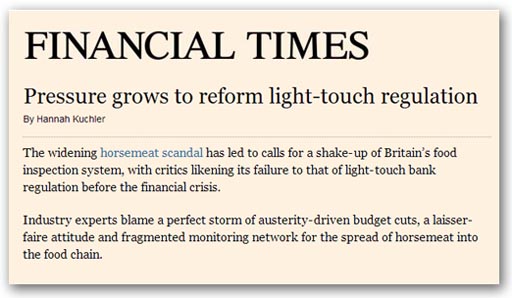
How typical it is of the British media (and this paper in particular) that the moment we get something of a food "crisis", up goes the cry for "more regulation", along with condemnation â as we
see here â of "light-touch regulation".
This comes from
FT journalist Hannah Kuchler, who may not have been around at the time of the Edwina Currie's "Salmonella in eggs", the Listeria scare, Mad Cow Disease and all the other scares of the late '80s and '90s, which spawned the current crop of regulation.
In this example of what the
FT calls "high quality global journalism", we get critics likening the failure of Britain's food inspection system to that of light-touch bank regulation before the financial crisis. Industry experts, we are told, blame "a perfect storm of austerity-driven budget cuts, a laisser-faire attitude and fragmented monitoring network for the spread of horsemeat into the food chain".
Before going any further, let us revisit
what we know of the causation of the horsemeat "crisis" and we can venture that, had the French food processor Comigel carried out pre-production tests of its frozen meat supply, then the horse meat most likely would have been detected and intercepted. The problems we are experiencing would not have occurred.
That assumes, of course â as the French government seems to think â that Comigel is innocent of fraud, and guilty of no more than "negligence". Thus, a simple in-house testing regime would have sufficed.
On this basis, the problem cannot in any way be attributed to a "light touch" regime. We are looking at a very specific system failure which, in our view was induced by the regulatory system itself. This is not too little regulation, but the wrong type of regulation.
Sadly, though, journalists â and indeed legislators and regulators â seem incapable of stepping past a childishly simple assessment, thinking of "too much or too little regulation". Their brains seem incapable of asking whether the right type of regulation has been adopted, and/or whether the model we have has been properly implemented.
Devoid of any such sophistication, we thus see Hannah Kuchler tell us that while DNA tests have been used to detect contamination since the crisis erupted, the technique has not previously been standard practice for inspectors. She then relies on a "recently retired [meat] inspector" to tell us that "it could have been possible to discover horsemeat with the naked eye". "Horsemeat does look different â it is darker, the fat is yellower and oilier", the inspector says.
At the user end, however, where the likes of trading standards and environmental health officers roam, we are dealing with a processed product. There, DNA testing is the most reliable technique to detect cross-species adulteration.
In the Comigel processing plant, though, we have already learned that the horsemeat meat was used frozen, in which case, visual appearance is of little relevance. One block of frozen meat looks very much like another. A simple "boiling test" would nevertheless have been adequate.
But this "recently retired inspector" is talking about abattoirs and cutting plants. Reductions in the number of inspections at cutting plants â after a change in EU law in 2004 â and pressure to work at speed in abattoirs, could have made horse meat harder to spot, he tells us. "Before we had two inspectors to work a body of beef and they'd do half each â now one does the lot. The volumes of work people have to do working as fast as the production line means you miss more things", he complains.
Budget cuts to the Food Standards Agency have contributed to a halving of the number of meat inspectors since the 1990s, though the number of meat plants has also fallen, we are then told. In the past three years local authority regulatory services have been slashed by 32 percent per person in real terms.
Yet the failures which are currently gripping the nation took place in a processing plant in another country, out of sight of inspectors - and out of reach of our own. The failures are a result of regulations mandated by the EU and enforced by the French authorities, under the supervision of EU officials. How could a drop in the number of meat inspectors or speeding up the work rate in UK plants be a contributory factor?
This, though, it what passes for an intelligent contribution to the debate, made all the more predictable and leaden by resurrecting the old war horse, professor Tim Lang, supposedly an "expert in food policy", but in fact a lefty campaigner. Using Lang is a bit like
Godwin's Law. Whomsoever quotes him has automatically lost the debate.
That, however, does not stop Kuchler, who then goes on to Liz Moran, president of the association of public analysts. She is allowed a few paragraphs of special pleading, then followed by Andy Foster from the Trading Standards Institute, who says some local authority sampling budgets have been cut by 50-70 percent.
This, it appears, is the best that the
Financial Times can offer, a piece of work for which the phrase "extruded verbal material" (EVM) was invented. The legacy media, as always, is writing itself out of the debate. It has nothing sensible to offer.
COMMENT: "HORSEMEAT" THREAD